Deriv Turkey Review 2026
Forex Trading Risk — Turkish Regulatory Notice (SPK)
Deriv — International Forex brokers reviewed on this site operate through foreign-regulated or offshore entities and are not licensed by the Capital Markets Board of Türkiye (SPK — Sermaye Piyasası Kurulu) under Capital Markets Law No. 6362 and Communiqué III-37.1. Domestic SPK-regulated leveraged trading in Türkiye is subject to a maximum 10:1 leverage cap and a 50,000 TRY minimum initial margin requirement. Trading with offshore platforms carries both financial risk (loss of capital) and regulatory limitations (no SPK investor compensation or Turkish court jurisdiction over offshore disputes).
Trading financial instruments involves significant risk. This review is for informational purposes only and does not constitute financial advice. Conduct your own due diligence.
Executive Summary: The Verdict at a Glance
Deriv is a long-standing broker that offers access to standard financial markets alongside algorithmic synthetic indices, which are internally simulated rather than market-driven. The platform operates completely offshore for Turkish residents without regulatory oversight from the Capital Markets Board (SPK), introducing a substantial counterparty risk that traders must manage independently. This broker is recommended primarily for experienced derivative traders who specifically require continuous 24/7 synthetic index speculation or seek a swap-free MT5 environment, and who possess the technical capacity to navigate VPN access and offshore payment channels.
Is Deriv Safe in Turkey? A Regulatory Deep-Dive
To evaluate the safety of Deriv within the Turkish borders, one must first dismantle the marketing narratives and look at the legal framework. The Capital Markets Board of Turkey (Sermaye Piyasası Kurulu - SPK) is the sole authority regulating retail financial trading in the country. Under SPK regulations, any broker operating without a direct license from the board is classified as unauthorized. Deriv does not hold, nor has it ever held, an SPK license. This lack of authorization means that the SPK actively blacklists Deriv's web domains, forcing Turkish traders to navigate access issues using virtual private networks (VPNs) or constantly hunt for mirror domains.
From a global perspective, Deriv is not completely unregulated. The broker operates under several international subsidiaries, holding licenses from the Malta Financial Services Authority (MFSA), the Labuan Financial Services Authority (Labuan FSA) in Malaysia, and the Vanuatu Financial Services Commission (VFSC). While these licenses sound official, they offer zero protection to retail traders residing in Turkey. When you open an account from Turkey, your contract is with the offshore subsidiary registered in Vanuatu or Labuan. If the broker faces insolvency, freezes your withdrawals, or executes trades with unusual slippage, you have no local legal recourse. The Investor Compensation Scheme of the European Union does not apply to accounts registered under these offshore branches.
Traders must also remember the fundamental reality of retail trading: between 74% and 89% of retail investor accounts lose money when trading contracts for difference (CFDs) and financial derivatives. When trading with an offshore entity like Deriv, the absence of a local regulatory safety net means your capital is exposed to the broker's own solvency and internal ethical standards. You are trading in a regulatory vacuum, and any capital deposited must be treated as high-risk risk capital.
Offshore Regulatory Risk
Platform Architecture, Execution Model & Order Types
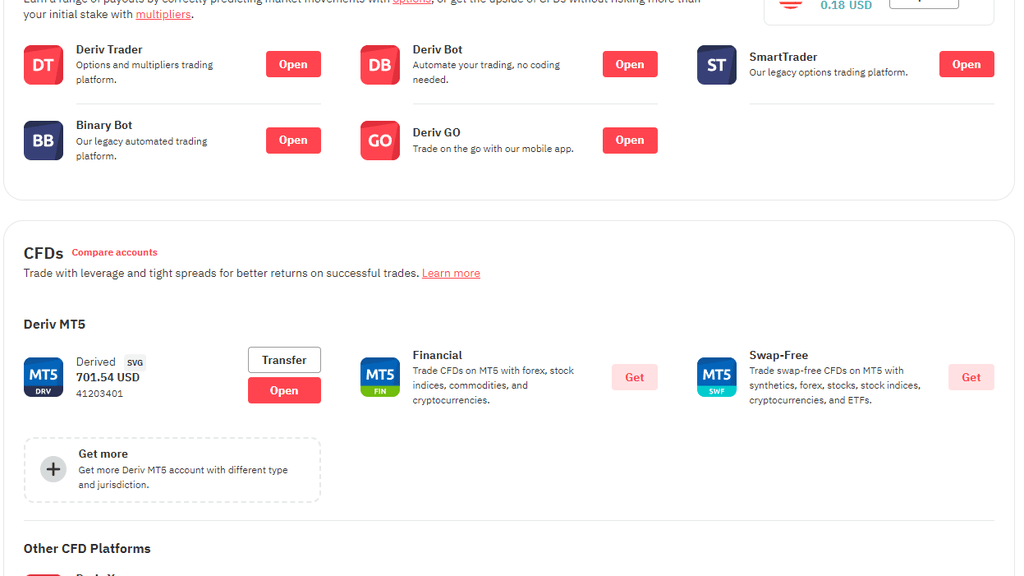
Deriv provides Turkish traders with access to Deriv MT5, Deriv cTrader, DTrader, Deriv X, SmartTrader, Deriv Bot, Deriv GO. Under its international onboarding structure (Deriv (SVG) LLC / Deriv (FX) Ltd (Labuan FSA) / Deriv (BVI) Ltd (BVI FSC)), trade routing follows an STP/Market Execution on MT5/cTrader Financial CFDs; Proprietary RNG + Dealing Desk on Synthetic Indices & Multipliers framework rather than domestic Borsa İstanbul (VİOP) or SPK-supervised Turkish liquidity pools.
Pricing and transaction costs depend directly on the selected account tier: From 0.5 pips on Derived/Financial MT5 accounts; fixed stake-based risk on DTrader Multipliers and Options. During standard London and New York session overlaps, major currency pairs and gold typically reflect baseline quoted spreads. However, during high-impact macroeconomic releases—such as US Consumer Price Index (CPI) prints, Non-Farm Payrolls (NFP), or Central Bank of the Republic of Türkiye (TCMB) Monetary Policy Committee (PPK) rate decisions—liquidity providers widen bid-ask spreads and market orders can experience positive or negative slippage.
| Infrastructure Dimension | Deriv Specification | Operational Impact for Turkish Traders |
|---|---|---|
| Contracting Legal Entity | Deriv (SVG) LLC / Deriv (FX) Ltd (Labuan FSA) / Deriv (BVI) Ltd (BVI FSC) | Offshore jurisdiction; outside SPK Communiqué III-37.1 & YTM compensation fund |
| Group Regulatory Licenses | MFSA (Malta), LFSA (Labuan), VFSC (Vanuatu), BVI FSC (British Virgin Islands) | Group entity oversight (does not extend statutory retail protection to Türkiye accounts) |
| Supported Platforms | Deriv MT5, Deriv cTrader, DTrader, Deriv X, SmartTrader, Deriv Bot, Deriv GO | Desktop, web, and mobile access (BTK domain blocks may affect web login without DNS/VPN) |
| Execution & Routing Model | STP/Market Execution on MT5/cTrader Financial CFDs; Proprietary RNG + Dealing Desk on Synthetic Indices & Multipliers | Market orders fill at volume-weighted available liquidity; stop orders can slip during news gaps |
| Spread & Commission Structure | From 0.5 pips on Derived/Financial MT5 accounts; fixed stake-based risk on DTrader Multipliers and Options | Rollover window (23:55–00:05 server time) widens spreads across FX and XAU/USD |
Traders utilizing pending orders (Buy Limit, Sell Limit, Buy Stop, Sell Stop) and automated Expert Advisors (EAs) should account for network latency between Turkish ISPs and European/UK trade servers, as well as potential BTK (Bilgi Teknolojileri ve İletişim Kurumu) domain restrictions on web-based terminals.
What You Can Actually Trade
Deriv provides an extensive range of assets, though the underlying mechanics of these assets differ significantly. Traders must understand what they are trading to manage their risk effectively.
Forex:The platform offers over thirty currency pairs, including majors, minors, and exotics. The major pairs offer the lowest spreads. Exotic pairs, specifically the USD/TRY (US Dollar to Turkish Lira), are available but carry extreme spreads that can exceed 180 pips during the market close. What's more, the overnight swap rates for USD/TRY are highly negative, which will erode your account balance if you hold long positions over several days.
CFDs on Stocks and Indices: Deriv allows traders to speculate on the price movements of major global stocks (such as Apple, Microsoft, and Tesla) and global indices (including the S&P 500, Nasdaq 100, and DAX 40). These are standard CFDs, meaning you do not own the underlying asset but trade the price difference. Leverage on stock CFDs is capped at 1:50, while indices can be traded with leverage up to 1:100.
Commodities: You can trade precious metals, including Gold (XAU/USD) and Silver (XAG/USD), alongside energy contracts like WTI Crude Oil and Brent. Gold spreads are volatile, averaging 2.5 to 3.5 pips during peak hours.
Synthetic Indices:These are Deriv's proprietary assets. Unlike real assets, synthetic indices (such as Volatility 75, Boom 1000, and Crash 1000) do not reflect real-world events. They are generated by a cryptographic random number generator. The broker claims these are audited for fairness by independent bodies, but the reality is that you are trading against a mathematical algorithm owned and operated by the broker. They are available 24/7/365, which is convenient, but the house edge is structurally built into the price feed.
Digital Options (Binary Options): Available on DTrader and SmartTrader. These options allow you to bet on the price direction of an asset over durations as short as one tick up to several days. Payouts range from 80% to 95% on successful trades. If your prediction is wrong by even a fraction of a pip, you lose the entire amount staked. The math behind binary options is structurally disadvantageous. A 90% payout requires a win rate of over 52.6% just to break even, a target that most retail traders fail to hit consistently.
Fee Structure: The Hidden Costs
Deriv markets itself as a low-cost broker, but a closer examination reveals several hidden fees that can impact your profitability. The spreads on their standard MT5 financial account are variable. For EUR/USD, the spread averages 0.6 pips under liquid conditions, which is competitive.
No commissions are charged on standard CFD trades, as the broker embeds their fee directly into the spread markup. Swap fees are calculated daily at 23:59 GMT. The formula for swap calculations on forex pairs is:
Swap = (Volume in Lots × Contract Size × Point Value) × Swap Rate in Points
Holding positions over Wednesday night incurs triple swap charges to account for weekend settlement, which is a standard industry practice but one that catches many retail traders off guard. For Turkish Lira pairs, the overnight swap costs are exceptionally high.
Deriv does offer swap-free accounts for traders who require Sharia compliance. These accounts remove interest charges on overnight positions, but the broker compensates for this by applying an administrative fee after a predetermined grace period (typically fourteen days).
One of the most punishing fees is the inactivity charge. Deriv charges a $25 fee if your account remains inactive for twelve consecutive months. This is higher than the industry average, where inactivity fees are typically capped at $10 per month or omitted entirely.
| Fee Category | Standard MT5 Account | Derived (Synthetic) Account | Offshore / Turkish Context |
|---|---|---|---|
| Average EUR/USD Spread | 0.6 pips (Variable) | Not Applicable | Subject to wider spreads during news |
| Commission | None | None | Built into spread markup |
| Inactivity Fee | $25 after 12 months | $25 after 12 months | Applied automatically to balance |
| Overnight Swaps | Variable (Triple on Wednesday) | None (Swap-free by design) | USD/TRY swaps are highly punitive |
| Swap-Free Account Option | Available (14-day grace period) | Standard setup | Admin fee applies after grace period |
The Turkey User Experience
Turkish traders face specific hurdles when dealing with offshore brokers, primarily related to payment processing and identity verification. Because the SPK does not license Deriv, direct credit card deposits and international bank wires from Turkish banks (such as Ziraat Bankası, Garanti BBVA, or Akbank) are frequently blocked or flagged by compliance departments.
To handle cross-border settlement friction, Deriv utilizes a network of Payment Agents in Turkey. These are peer-to-peer payment agents; however, Turkish residents should note that direct domestic bank transfers (Havale/EFT) and licensed e-wallets (such as Papara under Law No. 6493) are restricted for unlicensed offshore derivative platforms, making P2P cashier availability unverified and subject to counterparty risk. Once they receive your local transfer, they credit your Deriv account in USD. When you withdraw, the reverse process occurs. While this payment agent system is functional, it introduces counterparty risk. If the payment agent delays your transaction or disappears, Deriv will not take responsibility for the funds until they are credited to their platform. Always verify the agent’s credentials on the official Deriv portal before initiating a transfer.
Alternatively, traders can use cryptocurrencies such as Tether (USDT on the TRC20 network), Bitcoin, or Ethereum. This method is highly recommended as it avoids local banking compliance checks entirely. However, you must account for external wallet transfer fees and the volatility of the crypto assets during the transfer window.
Know Your Customer (KYC) verification is mandatory before any withdrawal can be processed. For Turkish residents, this requires submitting:
- A clear color scan of your Turkish National ID card (T.C. Kimlik Kartı) or passport.
- Proof of residency, which can be easily obtained by downloading a Yerleşim Yeri Belgesi (residence certificate) from the e-Devlet portal in PDF format.
- Verification is typically completed within twelve to twenty-four hours, though any discrepancy in name spelling will result in account suspension.
Pros & Cons Table
Below is a summary of the advantages and disadvantages of using Deriv for Turkish retail traders.
| Advantage (Pro) | Disadvantage (Con) |
|---|---|
| Operating history since 1999 (formerly Binary.com) providing operational stability. | Completely unlicensed by the Turkish SPK, requiring VPN access and alternative domains. |
| Unique synthetic indices tradable 24/7/365 without dependency on real-world market closures. | Synthetic indices are generated by internal algorithms, meaning you trade against the house. |
| Local payment agent network and cryptocurrency support to navigate cross-border settlement and regulatory restrictions. | High $25 inactivity fee charged after twelve months of account dormancy. |
Account Types
Deriv structures its accounts based on the assets you intend to trade and the platforms you prefer. Below are the primary options available to Turkish traders:
DMT5 Financial
Best for traditional asset classes, including forex, stock CFDs, and precious metals.
- • Spreads: From 0.5 pips
- • Leverage: Up to 1:1000
- • Min Deposit: $5
- • Platform: MT5
DMT5 Derived
Designed specifically for trading synthetic volatility, boom, and crash indices.
- • Spreads: Algorithmic
- • Leverage: Up to 1:1000
- • Min Deposit: $5
- • Platform: MT5
Swap-Free
Sharia-compliant account that removes overnight interest rates on selected financial assets.
- • Spreads: Marked up
- • Leverage: Up to 1:1000
- • Min Deposit: $5
- • Platform: MT5
Comparison with Relevant Alternatives in Turkey
Before opening an offshore account with Deriv, Turkish traders should compare its legal entity structure, spread-plus-commission costs, and platform reliability against peer international brokers and review our primary Turkish regulatory guides:
| Alternative Broker | Key Differentiation vs Deriv | Detailed Review |
|---|---|---|
| Exness Turkey Review | Tighter spot Forex & Gold spreads with instant USDT withdrawals | Read Audit → |
| IC Markets Turkey Review | Institutional ECN liquidity for pure Forex and Index scalping | Read Audit → |
| IQ Option Turkey Review | Alternative proprietary terminal for options and retail CFDs | Read Audit → |
| Eightcap Turkey Review | Direct TradingView integration for Forex and Crypto CFDs | Read Audit → |
Essential Turkish Regulatory & Strategy Guides
Final Verdict: Should You Open an Account?
Deriv is not a scam broker; its 25-year history since its inception as Binary.com demonstrates that it operates a stable business model. However, a stable business model does not guarantee your profitability. Retail trading remains a high-risk endeavor where 74-89% of accounts lose money.
If you are a Turkish trader looking for an SPK-compliant environment with domestic investor protection, Deriv is not for you. You will have to use VPNs to access the site, accept the risks of third-party payment agents, and trade in a legal vacuum.
For traders who understand these risks and specifically want to trade 24/7 synthetic indices or require a highly leveraged, swap-free MT5 environment, Deriv is a functional option. If you decide to proceed, keep your capital exposure minimal, verify your payment agents carefully, and never trade with money that you cannot afford to lose entirely.
Frequently Asked Questions
Rating Breakdown
Pros
- In business since 1999 (formerly Binary.com), offering a 25+ year track record
- Unique synthetic indices (Boom, Crash, Volatility) tradeable 24/7
- Low $5 minimum deposit and accessible $1 minimum trade size
- Multiple international funding rails including e-wallets and cryptocurrency
- Swap-free accounts available for halal compliance
Cons
- Turkish clients are onboarded via offshore entities (VFSC / Labuan); unlicensed by local Turkish SPK
- Synthetic indices are generated by internal algorithms rather than real markets
- Aggressive marketing of high-volatility products
Fees & Account Details
| Minimum Deposit | $5 |
| EUR/USD Spread | 0.5 pips (variable on MT5) |
| Commission | None |
| Withdrawal Time | 1-2 business days |
| Inactivity Fee | $25 after 12 months inactive |
| Platforms | DTrader, SmartTrader, Deriv MT5, Deriv X |
| Regulation | MFSA, Labuan FSA, VFSC |
Deriv Turkish Regulatory & Entity Applicability
Verified: 2026-10-17Important distinction between domestic SPK authorization, foreign group regulation, and actual contracting entity terms for residents of Türkiye.
| 1. Turkish SPK Authorization | ✗ Not licensed by SPK under Law No. 6362; non-EU Turkish residents contract with Deriv's offshore Labuan/Vanuatu/SVG subsidiaries. |
| 2. Group / Foreign Regulator Authorization | MFSA (Malta — IS/70156), Labuan FSA (Malaysia — MB/18/0024), VFSC (Vanuatu), BVIFSC (BVI) (Applies only to respective foreign subsidiaries) |
| 3. Contracting Entity for Turkish Clients | Deriv (FX) Ltd (Labuan FSA) / Deriv (V) Ltd (Vanuatu VFSC) / Deriv (SVG) LLC — Labuan (Malaysia) / Vanuatu / SVG (Offshore) |
| 4. Turkish Customer Eligibility | Accepts Turkish residents via offshore entities ($5 min. deposit) for MT5 CFDs and synthetic indices. |
| 5. Payment Rails (TRY / Bank / E-Wallet) | Direct domestic Turkish bank wires and licensed e-wallets (Papara under Law No. 6493) are restricted; supports USDT/BTC, Skrill, and Neteller. |
| 6. Turkish Language & TRT (GMT+3) Support | International / English desk |
Primary Regulatory References & Editorial Verification
Verification Date: 2026-10-17 · Last Editorial Update: 2026-10-17 · Methodology & Scope: This review is based on publicly disclosed broker fee schedules, client agreements, regulatory registry checks, and Turkish statutory frameworks. Payment method availability, spreads, and Turkish resident onboarding eligibility vary by contracting entity and may change without notice. We do not claim guaranteed execution results or personalized financial advice.
- Verified Regulator / Corporate Registry Reference: MFSA Malta (#IS/70156 — EU), Labuan FSA (#MB/18/0024) & VFSC Vanuatu — Primary verification source for Deriv group/contracting entity registration (Deriv (FX) Ltd (Labuan FSA) / Deriv (V) Ltd (Vanuatu VFSC) / Deriv (SVG) LLC).
- Capital Markets Board of Türkiye (SPK): spk.gov.tr — Authorized Intermediary Institutions (Yetkili Aracı Kurumlar) & Article 99 enforcement bulletins.
- SPK Legislation Portal: mevzuat.spk.gov.tr — Capital Markets Law No. 6362 & Communiqué III-37.1 (10:1 leverage cap & 50,000 TRY minimum initial margin).
- BDDK & MASAK Compliance: bddk.org.tr (Law No. 6493 payment rules) & masak.hmb.gov.tr (Law No. 5549 AML monitoring).
Sajid
Financial Markets Researcher & Regulatory Analyst
Trading since 2012
Last updated
2026-10-17
Financial markets researcher covering SPK regulations, broker entity disclosures, fee structures, and derivative risk management since 2012.
Forex Trading Risk — Turkish Regulatory Notice (SPK)
Deriv — International Forex brokers reviewed on this site operate through foreign-regulated or offshore entities and are not licensed by the Capital Markets Board of Türkiye (SPK — Sermaye Piyasası Kurulu) under Capital Markets Law No. 6362 and Communiqué III-37.1. Domestic SPK-regulated leveraged trading in Türkiye is subject to a maximum 10:1 leverage cap and a 50,000 TRY minimum initial margin requirement. Trading with offshore platforms carries both financial risk (loss of capital) and regulatory limitations (no SPK investor compensation or Turkish court jurisdiction over offshore disputes).